

Did you know that electrical faults are responsible for approximately 40% of all house fires across New South Wales? It is a sobering thought, especially when you are standing in the dark or worrying about a fridge full of food spoiling. You likely feel frustrated when a tripping circuit breaker in Sydney interrupts your work day or cuts the power right as you are cooking dinner. It is tempting to just keep flipping the switch back on; however, that repeated "click" is actually a vital safety warning that something is wrong within your wiring.
We understand that you want your power restored immediately without the fear of a hidden electrical fire. This article explains the root causes behind your frequent blackouts and provides the professional steps needed to fix the issue for good. You will discover how to identify overloaded circuits, understand the latest 2026 safety switch standards, and learn how a seasoned local sparky can ensure your home remains both functional and safe. We will also cover the new digital compliance requirements to ensure your property meets the current Building Commission NSW standards.
Key Takeaways
- Understand that a tripping circuit breaker Sydney homeowners encounter is a vital safety mechanism designed to prevent electrical fires and equipment damage.
- Learn to identify the difference between a safety switch (RCD) and a circuit breaker by looking for the "test" button on your switchboard.
- Discover the common causes for sudden power loss, including circuit overloads from high-wattage appliances and hazardous short circuits.
- Follow a safe, step-by-step guide to isolate faulty appliances yourself before you need to book a professional service.
- Find out how specialised diagnostic fault finding can pinpoint hidden electrical leaks behind your walls to provide a permanent solution.
Why is My Circuit Breaker Tripping in My Sydney Home?
Dealing with a tripping circuit breaker Sydney residents often find themselves in a loop of frustration, especially when the power cuts out during a humid afternoon. It is important to remember that your circuit breaker is not just a nuisance switch; it's your home's first line of defence against electrical fires. When the power cuts, it means the system has detected a hazard that could lead to overheating or a blaze. While a "protective trip" occurs because the breaker is doing its job, you might also experience "nuisance tripping" caused by a faulty, worn-out breaker that needs professional replacement.
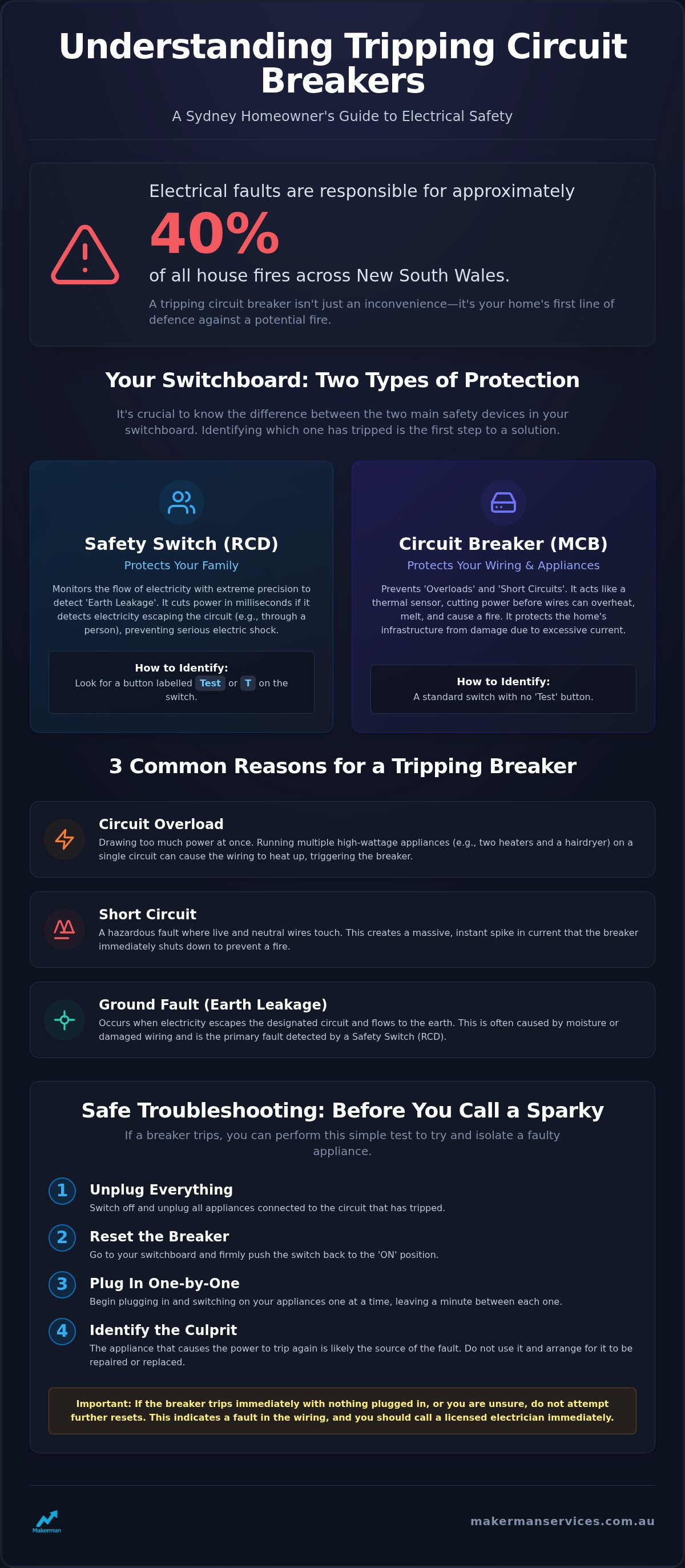
Most issues stem from three primary electrical faults. Circuit overloads happen when you draw too much power at once. Short circuits occur when wires touch where they shouldn't. Ground faults happen when electricity leaks to the earth. Sydney’s coastal humidity can often exacerbate these issues, as moisture can find its way into outdoor power points or aged wiring, triggering a trip even when everything seems fine inside.
The Role of the Switchboard in Modern Sydney Living
Sydney homes have changed significantly over the last few decades. We've moved from simple lighting and a fridge to high-draw environments filled with ducted air-conditioning, rapid EV chargers, and powerful induction cooktops. This shift places immense strain on older switchboards. If your property still uses an old-school fuse box with ceramic holders and replaceable wire, it's likely struggling to keep up with modern demands. Modern circuit breaker panels are designed to handle these loads more efficiently. Current Australian Standards, specifically AS/NZS 3000:2018, now require strict protection levels that many older Sydney homes simply don't meet. Upgrading to a modern board isn't just about convenience; it's about bringing your home up to the legal safety requirements for 2026.
What Happens During a 'Trip' Event?
When you hear that distinct "click" and the lights go out, a physical reaction has occurred inside your switchboard. To truly grasp what a circuit breaker is, you have to understand its internal mechanism. Most breakers use a bimetallic strip that bends when it gets too hot from an overload, or an electromagnetic coil that reacts instantly to a massive current spike like a short circuit. This physical movement forces the internal contacts apart to stop the flow of electricity. You should never force a breaker to stay in the "on" position if it keeps flipping back. Doing so bypasses the safety mechanism and can lead to a house fire. Tripping is the intentional interruption of electricity to prevent thermal runaway.
Understanding Your Switchboard: Safety Switches vs. Circuit Breakers
When the lights go out, your first instinct is to check the switchboard. However, the term "the power tripped" can refer to two very different safety events. Identifying which switch has flipped is the first step in solving the problem. You can easily identify a Safety Switch, also known as a Residual Current Device (RCD), by looking for a small button labelled "Test" or "T" on the face of the device. Standard circuit breakers do not have this button. Many modern Sydney renovations now utilise RCBOs. These are combination switches that handle both human safety and wire protection in one slim unit. It's essential to perform a six-monthly test on your RCDs. Simply press the test button to ensure the mechanical internal parts haven't seized over time. If the switch doesn't flip down instantly, it won't protect you in a real emergency.
Circuit Breakers (MCB): Protecting Your Wires
A Miniature Circuit Breaker (MCB) focuses on protecting your home’s electrical infrastructure. Its main role is to prevent an "Overload" situation. Consider a typical Sydney winter. You might plug in two high-wattage portable heaters and a hairdryer on the same bedroom circuit. This creates a massive demand for current. Without a functioning MCB, the copper wiring hidden behind your gyprock would begin to glow red hot. Eventually, the plastic insulation would melt, leading to a structural fire. The MCB acts as a thermal sensor. It cuts the power before the heat reaches a critical level. If you're constantly dealing with a tripping circuit breaker Sydney households often find that redistributing heavy appliances to different circuits stops the issue immediately.
Safety Switches (RCD): Protecting Your Family
While breakers protect the house, safety switches protect the people inside it. An RCD monitors the flow of electricity with extreme precision. It detects "Earth Leakage," which is when electricity escapes the circuit and tries to find a path to the ground. This could happen if a child pokes something into a socket or if a toaster has a faulty internal element. The RCD can shut off the power in roughly 0.03 seconds. This is fast enough to prevent a lethal heart arrhythmia from an electric shock. Under New South Wales regulations, every power and lighting circuit must be protected by an RCD. If your switchboard still relies on old ceramic fuses, you're missing this life-saving technology. Booking a professional electrical safety inspection is the best way to ensure your family is fully protected against current leakage and faulty appliances.
5 Common Reasons for a Tripping Breaker in Sydney
A tripping circuit breaker Sydney households experience isn't always a sign of a massive disaster. Often, it's a simple case of modern life outstripping your home's electrical capacity. Identifying the specific cause helps you decide whether you can fix it yourself or if you need to call in a professional for specialised electrical fault finding. Here are the five most frequent culprits.
- Circuit Overload: This happens when you plug too many high-wattage devices into one circuit. Running a kettle, toaster, and air fryer simultaneously is the classic kitchen disaster.
- Short Circuit: A "hard" fault where an active wire touches a neutral wire. This causes a massive current spike that triggers the breaker instantly.
- Ground Fault: Similar to a short circuit, but electricity leaks to the earth wire. This is often caused by water ingress or damaged internal wiring.
- Faulty Appliances: A dodgy old fridge or a cheap, unbranded power board can develop internal faults that take down the entire house.
- Environmental Factors: Sydney’s unique climate and local wildlife play a bigger role than most people realise.
While many of these issues are universal, Sydney’s specific geography creates unique challenges for residential wiring. If you've lived in the same property for years, you might not notice the slow degradation caused by the local environment until the lights suddenly go out.
Sydney’s Humidity and Coastal Salt Air
Living near the water in suburbs like Bondi or Manly has its perks, but the salt air is brutal on electrical components. Salt spray causes rapid terminal corrosion in outdoor power points and light fittings. This creates high resistance and heat, leading to frequent trips. Sydney’s high humidity also increases the likelihood of "nuisance tripping" because moisture can make safety switches more sensitive to tiny, harmless current leaks. If your power cuts out after a heavy Sydney downpour, your outdoor garden lights or pool pump are almost certainly the primary suspects.
The 'Pest' Factor: Geckos and Rodents
In Western Sydney and the Hills District, geckos are a constant menace for switchboards. These small lizards love the warmth of the electrical cabinet. Unfortunately, they often bridge the gap between live components, causing an instant short circuit that fries the gecko and trips your power. Rodents are another major issue, especially in the roof voids of older Parramatta homes. Rats and mice chew through cable insulation, leaving exposed copper that eventually touches a timber beam or another wire. Professional fault finding is the only way to identify these hidden organic causes before they lead to a structural fire. A tripping circuit breaker Sydney homeowners ignore can quickly escalate from a minor pest problem to a major safety hazard.
Safe Troubleshooting: Before You Call an Electrician
Safety is the absolute priority when dealing with a tripping circuit breaker Sydney homeowners often encounter. While it is frustrating to be without power, you must never attempt to open the switchboard cover or touch any exposed wiring. These components carry lethal voltages. However, you can perform a safe "process of elimination" from inside your home to see if a faulty appliance is the culprit. This simple diagnostic approach can often save you the cost of a service call if the problem is just a dodgy toaster or an old kettle.
First, determine which circuit has failed. Most switchboards are clearly labelled. If your lights are still on but the power points have failed, the issue is on a power circuit. If the entire house is dark, the main safety switch has likely tripped. If you find that the breaker trips immediately even when you think nothing is running, you must stop all DIY efforts. This usually indicates a "hard fault" in the permanent wiring that requires a licensed professional.
Step-by-Step Appliance Isolation Guide
This method is the most effective way to find a faulty device without needing specialised tools. Follow these steps carefully:
- Step 1: Turn the tripped breaker to the "off" position. Walk through your home and physically unplug every single appliance on that specific circuit. Do not just turn them off at the wall; you must pull the plug out.
- Step 2: Return to the switchboard and reset the breaker to the "on" position. If it stays up, the fault is almost certainly in one of your appliances rather than the house wiring.
- Step 3: Go back inside and plug your appliances in one at a time. Turn each one on and wait a few seconds.
- Step 4: When the breaker finally trips again, you have found your culprit. Label that device as faulty and leave it unplugged.
If your troubleshooting points to a more complex wiring issue or the breaker won't stay up even with everything unplugged, you should book professional electrical fault finding to prevent further damage to your home.
Recognising the Signs of a 'Bad' Breaker
Sometimes the breaker itself is the problem. Like any mechanical device, circuit breakers wear out over decades of use. You should check for visible discolouration or scorch marks around the switch. A faint burning smell near the switchboard is a critical warning sign of an active electrical fire risk. Physically, a healthy breaker should have a firm, crisp "click" when moved. If the switch feels "spongy," loose, or refuses to lock into the "on" position, the internal mechanism has likely failed. A breaker that feels hot to the touch is an immediate emergency. This indicates a loose connection or an internal failure that is generating dangerous levels of heat behind the panel.
Professional Fault Finding: Why Sydney Locals Trust Makerman Services
When basic troubleshooting doesn't solve the issue, you need a specialist who understands the intricacies of local electrical infrastructure. Makerman Services brings over 30 years of experience to every call-out, having diagnosed every imaginable cause for a tripping circuit breaker Sydney homes have faced since 1994. We don't just flip switches and hope for the best. Our team uses advanced diagnostic tools, including insulation resistance testers, to find tiny current leaks hidden deep behind your walls or under floorboards. This level of precision is essential for preventing recurring faults and ensuring your property remains safe from fire hazards.
Transparency is a core value of our service. Many homeowners worry about the cost of professional repairs, which is why we developed our unique Online Electrical Estimator. This tool allows you to get a clear ballpark figure before we even arrive on site. It removes the guesswork and ensures you aren't hit with unexpected bills. For Sydney property managers and strata committees, our fast-response maintenance service provides the reliability needed to keep tenants safe and properties compliant with the latest 2026 NSW safety regulations.
Our Diagnostic Process for Recurring Trips
Our approach is systematic and thorough. We start with a comprehensive visual inspection of your switchboard and sub-circuits, looking for signs of Sydney-specific wear like salt air corrosion or pest damage. We then conduct continuity and insulation testing to pinpoint the exact location of a fault within your wiring. Once the repair is finished, we provide a Certificate of Compliance for Electrical Work (CCEW) lodged through the mandatory Building Commission NSW eCert portal. This gives you a digital audit trail and proof that the work meets the highest Australian safety standards.
Emergency 24/7 Support Across Sydney
Electrical emergencies don't wait for business hours. Whether you are in Georges Hall, Bankstown, or the CBD, we provide rapid response support to restore your power. This is particularly critical for commercial and retail properties where a power failure means lost revenue and spoiled stock. Our team is ready to act at any time of day or night to secure your premises and fix the root cause of the trip. We prioritise your peace of mind by delivering efficient, high-standard repairs that stand the test of time. Get an instant ballpark with our Online Electrical Estimator or call us for 24/7 emergency support.
Restore Permanent Power to Your Sydney Property
A tripping circuit breaker Sydney residents frequently ignore can lead to significant safety risks and expensive property damage. You now have the tools to distinguish between a simple appliance overload and a more serious wiring fault. Remember to test your safety switches every six months and use the isolation method to identify faulty devices before seeking professional help.
When troubleshooting isn't enough, you need a specialist who understands the local landscape. Makerman Services offers over 30 years of Sydney electrical experience. We are fully licensed and insured for both residential and commercial work. Whether it's a corroded outdoor point or a pest infestation in your switchboard, we've seen it all. Our team provides 24/7 emergency response across Sydney's West to ensure you're never left in the dark.
Don't let electrical uncertainty disrupt your home or business. Use our Online Electrical Estimator to budget for your repair and take the first step toward a safer, more reliable electrical system. We're ready to help you get the lights back on for good.
Frequently Asked Questions
Why does my circuit breaker trip when nothing is turned on?
This usually indicates a "hard fault" within the permanent wiring of your home or environmental interference. Moisture ingress from a recent storm or a pest interfering with the internal terminals can trigger a trip even with all appliances unplugged. It's a sign that the issue is located behind your walls or within the switchboard itself, requiring professional diagnostic tools to locate.
Is it dangerous to keep resetting a tripped circuit breaker?
Yes, repeatedly resetting a breaker without identifying the fault is a significant fire risk. Every trip is a response to a safety hazard like excessive heat or a current spike. Forcing the switch back to "on" can cause the copper wiring to overheat and melt its plastic insulation. If a breaker trips a second time immediately after a reset, you must leave it off and call a licensed sparky.
How much does it cost to fix a tripping circuit breaker in Sydney?
The total cost depends on whether you need a simple component replacement or extensive fault finding for a hidden wiring issue. Most local electricians charge a standard call-out fee plus an hourly rate for the time spent diagnosing the fault. We provide an online estimator so you can get a transparent ballpark figure for your specific repair before booking a technician.
Can a faulty appliance cause the whole house to lose power?
Yes, a single device can black out the entire property if it triggers the main safety switch (RCD). In many Sydney homes, one RCD protects multiple power and lighting circuits simultaneously. When that switch detects a current leak from a dodgy appliance, it cuts power to everything it monitors to prevent a lethal electric shock.
What is the difference between a fuse and a circuit breaker?
A fuse is an older safety device containing a wire that physically melts when the current gets too high, requiring a manual wire replacement. A circuit breaker is a modern mechanical switch that simply flips to the "off" position. Breakers are much faster, more reliable, and designed to handle the higher electrical demands of a modern 2026 household.
Does Sydney's humidity affect my electrical switchboard?
High humidity is a frequent cause of a tripping circuit breaker Sydney residents deal with during the summer. Moisture can build up inside outdoor power points or garden lighting, creating a path for electricity to leak to the earth. This environmental moisture often makes safety switches more sensitive, leading to "nuisance trips" that occur more often on muggy days.
When should I call an emergency electrician for a tripping breaker?
You should seek emergency assistance immediately if you smell burning, see smoke, or notice scorch marks on your switchboard. A panel that feels hot to the touch is also a critical warning sign of an impending electrical fire. Don't wait if your power loss affects essential medical equipment or if you're unable to secure your property due to a total blackout.
How do I know if my circuit breaker itself is faulty and needs replacing?
A failed breaker often feels "spongy" or lacks a firm, crisp click when you move the switch. It might refuse to lock into the "on" position even when there is no load on the circuit. If you hear a faint buzzing or crackling sound coming from the switchboard, the internal contacts have likely worn out and require an urgent professional replacement.
